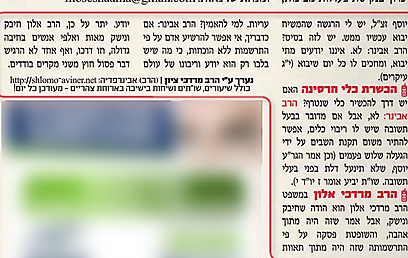
Harav Eliyahu: The Emmanuel Rozen Story Proves Women Shouldn't Serve In The IDFWhat exactly is the logic here? Harav Eliyahu's basic argument is that sexual harassment is endemic in society, and as such we shouldn't be allowing women to serve together with men. Fair enough. However the same logic can only really lead to a completely segregated society - something that is non existent even in the Haredi community. Moreover, considering by the amount of sexual scandals that we keep hearing about in Haredi communities, it would seem that the same logic would demand that we all send our female daughters to live their lives in closed nunneries, preferably somewhere in Siberia.
Mostly Kosher
Musings that are on balance - Kosher.
Friday, May 17, 2013
Scratching My Head
This headline has me scratching my head (translated):
Thursday, May 16, 2013
Not From The Onion: Venezuela Minister Blames Toilet Paper Shortage on Media
From the Guardian:
First milk, butter, coffee and cornmeal ran short. Now Venezuela is running out of the most basic of necessities – toilet paper....
President Nicolás Maduro, who was selected by the dying Hugo Chávez to carry on his "Bolivarian revolution", claims that anti-government forces, including the private sector, are causing the shortages in an effort to destabilise the country.
The government this week announced it also would import 760,000 tonnes of food in addition to the 50m rolls of toilet paper.
Commerce minister Alejandro Fleming blamed the shortage of toilet tissue on "excessive demand" built up as a result of "a media campaign that has been generated to disrupt the country".
I hate it when the media uses its powers to generate an excessive demand for toilet paper. Good luck Venezuela.
Wednesday, May 15, 2013
Things You Don't Need A PhD to Know
Last week it was reported that two UNRWA reps posed in front of a map where "Israel" was replaced with "Palestine". As someone who is a current Ph.D candidate, I was somewhat amused by this comment by Israel's Ambassador to the UN Ron Prosor:
"It doesn't take a PhD in Middle Eastern history or geography to know that a map of the Middle East that doesn't include Israel is deeply and profoundly prejudiced".
Sunday, May 12, 2013
On Avoiding a Schism In Religious Zionist Community
Harav Elyakim Levanon, one of the better known Hardalnick rabbis sent a letter last night to the members of the Jewish Home, urging them to support Harav Ariel's candidacy to the position of Chief Rabbi in order to prevent a schism in the Religious Zionist community. As most people know, Religious Zionism is going through a phase where there are two prominent camps - the more open liberal camp, and the more closed Hardalnick camp - Hardal being a slightly derogatory term meaning חרדי דתי לאומי.
There are two points that should be clarified:
1. The Hardal camp needs to stop threatening with a schism whenever they loose a fight. If they are the minority in RZ (which I think, but can't prove that they are) they need to accept it and stop being so threatening.
2. It takes quite a bit of twisted logic to understand how Harav Ariel will prevent a schism. Harav Ariel is not really a compromise between the two camps. Admittedly, Harav Ariel was probably not the first choice of the Hardalnick side of the RZ map. They probably would have preferred Harav Igra, or Harav Shapira. However Harav Ariel was not a compromise between the two camps. Harav Druckman decided (for everyone) unilaterally to push Harav Ariel's candidacy and make a political deal with Shas. While Harav Ariel is a better, more moderate candidate than other Hardalnick approved alternatives a compromise is not done unilaterally. From the Liberal RZ side, the election of Harav Ariel will be seen as a failure.
There are two points that should be clarified:
1. The Hardal camp needs to stop threatening with a schism whenever they loose a fight. If they are the minority in RZ (which I think, but can't prove that they are) they need to accept it and stop being so threatening.
2. It takes quite a bit of twisted logic to understand how Harav Ariel will prevent a schism. Harav Ariel is not really a compromise between the two camps. Admittedly, Harav Ariel was probably not the first choice of the Hardalnick side of the RZ map. They probably would have preferred Harav Igra, or Harav Shapira. However Harav Ariel was not a compromise between the two camps. Harav Druckman decided (for everyone) unilaterally to push Harav Ariel's candidacy and make a political deal with Shas. While Harav Ariel is a better, more moderate candidate than other Hardalnick approved alternatives a compromise is not done unilaterally. From the Liberal RZ side, the election of Harav Ariel will be seen as a failure.
Saturday, May 11, 2013
New York Time's Gets a Lesson In Kosher
The New York Times reported the following story of an unusual type of pig:
That last sentence caused the New York Times to publish the following correction:
Via @Yair_Rosenberg
What’s new at the Queens Zoo these days is three female mulefoot hogs.The mulefoot, a domestic hog named for its unusual non-cloven hoof, is black, beautiful and classified as “critically rare” by the American Livestock Breeds Conservancy.A century ago, according to the conservancy, the mulefoot was widely bred in the Midwest “for ease of fattening and production of meat, lard and especially hams.” But it is no longer commonly bred by farmers, the zoo said.The ladies, still unnamed, are a year old and can be visited on the zoo’s farm.It was not immediately clear whether the meat of hogs with uncloven hooves was considered kosher.
That last sentence caused the New York Times to publish the following correction:
Update, 4:26 p.m. | City Room, based on its extremely poor religious training, made the mistake above of wondering aloud whether meat from a pig with an uncloven hoof would still be considered nonkosher.Rabbi Moshe Elefant, chief operating officer of the kashrut division of the Orthodox Union, the largest kosher certification organization in the world, quickly set us straight.“Actually this pig is even worse than all other pigs,” he said. “Not only does it not chew its cud, it doesn’t have a split hoof.”Split hoof = kosher. Unsplit = nonkosher. The thing that makes pigs nonkosher is that they don’t chew their cud. We will remember this. Thanks, Rabbi.
We will remember this too. Thanks, Rabbi.
Via @Yair_Rosenberg
Some Short Thoughts On why the The Ariel-Amar Deal Won't Happen
Makor Rishon dedicated their weekend edition to coverage of the Chief Rabbi race (Israel). Much of the discussion was an analysis of whether the Amar-Ariel deal will actually occur. Just to remined everyone, the deal is supposed to be that the Jewish Home will use their power in government to pass a law allowing Sephradic Chief Rabbi Amar to serve a second term. In return Shas is meant to endorse rabbi Ariel as the Ashkenazic Chief Rabbi. The assumption being that Shas is still the strongest actor in the voting body that will elect the next Chief Rabbi. There is one other catch. The Jewish Home will need to change the law for Harav Ariel too - as he is currently older than the maximum age set in the law.
Here are some quick insights I gained, all explaining why the deal is unlikely to occur:
1. The deal has a built in flaw. Shas will get what they want immediately with the passing of the law allowing Rav Amar to run again. The Jewish Home will however have to wait a few months before the elections take place. During those months, Shas could withdraw their support for any reason.
2. Second internal flaw - The vote for Chief Rabbi is secret. Shas can't promise that its people will vote how they are told. Additionally, those voting may "read between the lines" and vote for a candidate Shas really want. In short, Shas can't guarantee other people will fulfill their will.
3. There is some doubt whether Shas really wants Rav Amar to be Chief Rabbi a second time. A lot of people think that Harav Ovadia really wants his son to have the position.
4. The deal was made with Eli Yishai - who is now no longer the head of Shas. Aryeh Deri is considered less trustworthy making it harder for the Jewish Home to trust him to deliver (see points 1+2).
5. The Jewish Home still can't get its act together and decide who they want for the job. Harav Stav is still considered the liberal choice.
6. Yesh Atid, Yisrael Beytenu and Hatenuah all endorse Stav. Yesh Atid itself is enough to block any changes in the law.
Here are some quick insights I gained, all explaining why the deal is unlikely to occur:
1. The deal has a built in flaw. Shas will get what they want immediately with the passing of the law allowing Rav Amar to run again. The Jewish Home will however have to wait a few months before the elections take place. During those months, Shas could withdraw their support for any reason.
2. Second internal flaw - The vote for Chief Rabbi is secret. Shas can't promise that its people will vote how they are told. Additionally, those voting may "read between the lines" and vote for a candidate Shas really want. In short, Shas can't guarantee other people will fulfill their will.
3. There is some doubt whether Shas really wants Rav Amar to be Chief Rabbi a second time. A lot of people think that Harav Ovadia really wants his son to have the position.
4. The deal was made with Eli Yishai - who is now no longer the head of Shas. Aryeh Deri is considered less trustworthy making it harder for the Jewish Home to trust him to deliver (see points 1+2).
5. The Jewish Home still can't get its act together and decide who they want for the job. Harav Stav is still considered the liberal choice.
6. Yesh Atid, Yisrael Beytenu and Hatenuah all endorse Stav. Yesh Atid itself is enough to block any changes in the law.
Friday, May 10, 2013
In Memory of Professor Geza Vermes 1924-2013
Guest Post
Professor Geza Vermes, 1924 - 2013
One of the most unusual figures in academic Jewish life, Professor Geza Vermes, Emeritus Professor of Jewish Studies at Oxford, passed away on May 8, aged 88.
Others will memorialize in detail his very considerable academic achievements. His personal history was remarkable. Vermes was born into an assimilated Hungarian Jewish family, who converted to Catholicism when he was a child. He was able to survive the war in Catholic seminaries, although both of his parents perished in Auschwitz. He was ordained as a Catholic priest, and after the war, at the University of Louvain, became the Church's expert on the newly-discovered Dead Sea Scrolls. (The first editions of his works on the DSS bore the Catholic imprimatur!). However, his academic work lead him to personally reassess his Catholic faith, and he moved to the UK, as a lecturer at Newcastle University, where for a time he was a member of a small Protestant church. At some point he left Christianity - but not Jesus - altogether, and, rather gingerly, identified as a Liberal Jew, although he rarely, if ever, identified with any Jewish community. In 1965 he was appointed to Oxford University, becoming Reader in Jewish Studies in the early 1970's (the successor to Cecil Roth) and then the first full Professor - appointments that scandalised the Anglo-Jewish 'Establishment'.
He had two academic passions - the Dead Sea Scrolls and the Jewish background of Jesus and early Christianity. Vermes was a meticulous scholar with a profound knowledge of inter-testamental Jewish literature, Midrash and rabbinic writings. He knew Talmud thoroughly, but in a totally academic fashion. He was personally responsible for forcing a revision of conventional Christology through his widely-read book, 'Jesus the Jew', and his subsequent works, where he portrayed Jesus as a sort of Galilean 'maggid' in a circle of charismatic rabbis including Honi haMa'agal and others. He showed the rabbinic and midrashic origins and techniques of the teachings of Jesus as preserved in the Gospels, and, although never promoting any religious agenda (what exactly did he believe?), championed Jesus as a revolutionary and profound ethical teacher. In a diffferent field, he did enormous work on the Dead Sea Scrolls, including translation of the complete corpus. Under his influence, 'Jewish Studies' at Oxford (and in the UK generally) became identified with what he termed the 'Intertestamental period'. He raised a generation of academic disciples.
As a graduate student in the early 1970's, sitting in his seminars on Pirkei Avot at the Oriental Institute in Oxford was a remarkable experience. In a soft, hissing Hungarian-accented English, he minutely analysed every personality and every saying in its historical, religious and political context. He was totally immersed in the world of the Rabbis, even as he was the most unrabbinical figure one could imagine. Until very late in life, he was extremely reticent about his personal life, and about his personal identity. About the only time I ever heard him allude to his rather bizarre life journey was once when he recalled his Newcastle days, going to the Yeshivah bookshop in Gateshead ('Lehmann's') to find some obsecure Midrashic texts, giggling as he described the reactions of 'the Yeshivah bochurs' to this 'strange apparition'. His first wife, Pamela, who passed away in 1993, wrote on Martin Buber. They lived outside Oxford, where they had pet Alsatians - who at one point 'adopted' and suckled some kittens. The symbolism was not lost on him.
Vermes was a gentleman, unfailingly courteous to all (although he did not mince words in his academic judgements). He was a scholar who was very independent and very original, but whose every word was carefully substantiated in deep textual proof. It is perplexing to speculate where, and in whose company, he will take his seat in heaven!
Paul Shaviv
Wednesday, May 8, 2013
A Legend Of Jerusalem From The 12 Century
In honor of Yom Yerushalim, I thought to share this story from the Itinerary of Benjamin of Tudela. It is commonly thought that BoT started his travels in the year 1160:
Jerusalem is surrounded by high mountains. On Mount Sion are the sepulchers of the house of David, and those of the kings who reigned after him. In consequence of the following circumstance, however, this place is at present hardly to be recognized. Fifteen years ago, one of the walls of the place of worship on Mount Sion fell down, and the patriarch commanded the priest to repair it. He ordered stones to be taken from the original wall of Sion for that purpose, and twenty workmen were hired at stated wages, who broke stones from the very foundation of the walls of Sion. Two of these laborers, who were intimate friends, upon a certain day treated one another, and repaired to their work after their friendly meal. The overseer accused them of dilatoriness, but they answered that they would still perform their day's work, and would employ thereupon the time while their fellow laborers were at meals. They then continued to break out stones, until, happening to meet with one which formed the mouth of a cavern, they agreed to enter it in search of treasure, and they proceeded until they reached a large hall, supported by pillars of marble, encrusted with gold and silver, and before which stood a table, with a golden scepter and crown. This was the sepulcher of David, King of Israel, to the left of which they saw that of Solomon in a similar state, and so on the sepulchers of all the kings of Juda, who were buried there. They further saw chests locked up, the contents of which nobody knew, and were on the point of entering the hall, when a blast of wind like a storm issued forth from the mouth of the cavern so strong that it threw them down almost lifeless on the ground. There they lay until evening, when another wind rushed forth, from which they heard a voice like that of a man calling aloud, "Get up, and go forth from this place." The men rushed out full of fear, and proceeded to the patriarch to report what had happenedMiracles are fairly rare in Benjamin of Tudela's diary. Joshua Prawer estimates that Benjamin of Tudela visited Jerusalem roughly in 1169-1171. If so the story of the workers should have occured sometime in 1154-1156. Prawer can not find any mention of an event on Mount Zion during those years, except for a lightning bolt hitting a church in 1146 (10 years too early). R. Abraham el Constatini is almost certainly the same as mentioned in the travels of Rabbi Petachia of Ratisbon, and is probably a member of Chasidei Ashkenaz.
p. 394
to them. This ecclesiastic summoned into his presence R. Abraham el Constantini, a pious ascetic, one of the mourners of the downfall of Jerusalem, 14 and caused the two laborers to repeat what they had previously reported. R. Abraham thereupon informed the patriarch that they had discovered the sepulchers of the house of David and of the kings of Juda. The following morning the laborers were sent for again, but they were found stretched on their beds and still full of fear; they declared that they would not attempt to go again to the cave, as it was not God's will to discover it to any one. The patriarch ordered the place to be walled up, so as to hide it effectually from every one unto the present day. The above-mentioned R. Abraham told me all this.
Tuesday, May 7, 2013
A Good Way To Describe The Bible?
A Commonplace Blog:
I liked the description. A shame the rest of his post is so terribly unconvincing.
In my classes on the Bible as literature, in fact, I like to tell my students that the book might be more accurately called The Norton Anthology of Ancient Hebrew Literature. It is, in any event, a library—and no singular term, certainly not “1,000-page morality tale,” can adequately describe it. It contains tales, yes; but also historical chronicles, genealogies, songs and poems, legal codes, sermons, political tracts and propaganda, prayers, elegies, allegories, dream visions and apocalyptic visions, and proverbs and other wisdom literature. The only true “morality tale” is the book of Job, which belongs to that last genre.
I liked the description. A shame the rest of his post is so terribly unconvincing.
Subscribe to:
Posts (Atom)